
Protein Molecular Weight Markers

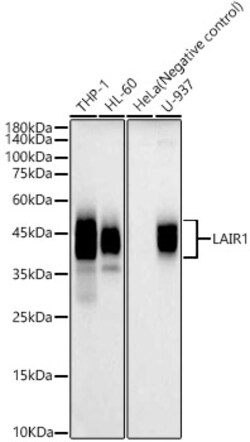
ABclonal Technology LAIR1 Rabbit pAb

The protein encoded by this gene is an inhibitory receptor found on peripheral mononuclear cells, including natural killer cells, T cells, and B cells. Inhibitory receptors regulate the immune response to prevent lysis of cells recognized as self. The gene is a member of both the immunoglobulin superfamily and the leukocyte-associated inhibitory receptor family. The gene maps to a region of 19q13.4 called the leukocyte receptor cluster, which contains at least 29 genes encoding leukocyte-expressed receptors of the immunoglobulin superfamily. The encoded protein has been identified as an anchor for tyrosine phosphatase SHP-1, and may induce cell death in myeloid leukemias. Alternative splicing results in multiple transcript variants.

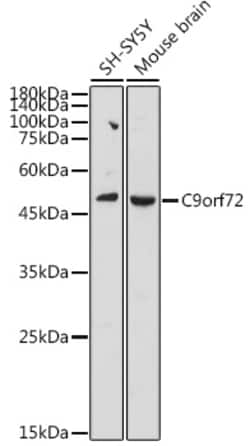
ABclonal Technology C9orf72 Rabbit pAb
The protein encoded by this gene plays an important role in the regulation of endosomal trafficking, and has been shown to interact with Rab proteins that are involved in autophagy and endocytic transport. Expansion of a GGGGCC repeat from 2-22 copies to 700-1600 copies in the intronic sequence between alternate 5 exons in transcripts from this gene is associated with 9p-linked ALS (amyotrophic lateral sclerosis) and FTD (frontotemporal dementia) (PMID 21944778, 21944779). Studies suggest that hexanucleotide expansions could result in the selective stabilization of repeat-containing pre-mRNA, and the accumulation of insoluble dipeptide repeat protein aggregates that could be pathogenic in FTD-ALS patients (PMID 23393093). Alternative splicing results in multiple transcript variants encoding different isoforms.
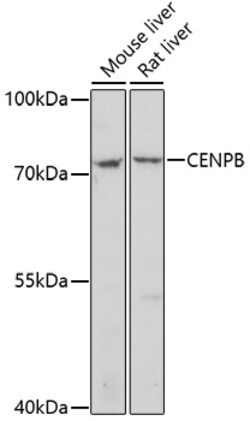
ABclonal Technology CENPB Rabbit pAb
This gene product is a highly conserved protein that facilitates centromere formation. It is a DNA-binding protein that is derived from transposases of the pogo DNA transposon family. It contains a helix-loop-helix DNA binding motif at the N-terminus, and a dimerization domain at the C-terminus. The DNA binding domain recognizes and binds a 17-bp sequence (CENP-B box) in the centromeric alpha satellite DNA. This protein is proposed to play an important role in the assembly of specific centromere structures in interphase nuclei and on mitotic chromosomes. It is also considered a major centromere autoantigen recognized by sera from patients with anti-centromere antibodies.
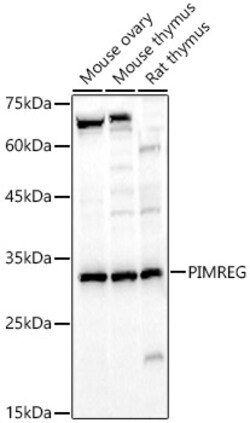
ABclonal Technology PIMREG Rabbit pAb
Predicted to be involved in cell division. Located in nucleolus and nucleoplasm.

ABclonal Technology EYA3 Rabbit pAb
This gene encodes a member of the eyes absent (EYA) family of proteins. The encoded protein may act as a transcriptional activator and have a role during development. It can act as a mediator of chemoresistance and cell survival in Ewing sarcoma cells, where this gene is up-regulated via a micro-RNA that binds to the 3 UTR of the transcript. A similar protein in mice acts as a transcriptional activator. Alternative splicing of this gene results in multiple transcript variants.
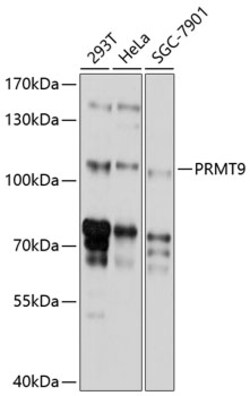
ABclonal Technology PRMT9 Rabbit pAb
This gene encodes a type II methyltransferase. Post-translational modification of target proteins by PRMTs plays an important regulatory role in many biological processes, whereby PRMTs methylate arginine residues by transferring methyl groups from S-adenosyl-L-methionine to the guanidino nitrogen atoms of arginine. The protein encoded by this gene methylates spliceosome associated protein 145 to regulate alternative splicing and acts as a modulator of small nuclear ribonucleoprotein maturation. Alternatively spliced transcript variants encoding multiple isoforms have been observed for this gene.
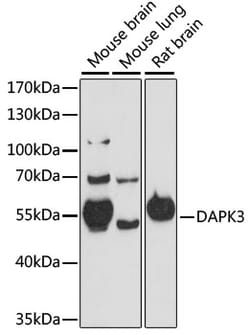
ABclonal Technology DAPK3 Rabbit pAb
Death-associated protein kinase 3 (DAPK3) induces morphological changes in apoptosis when overexpressed in mammalian cells. These results suggest that DAPK3 may play a role in the induction of apoptosis.
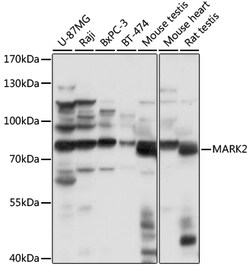
ABclonal Technology MARK2 Rabbit pAb
This gene encodes a member of the Par-1 family of serine/threonine protein kinases. The protein is an important regulator of cell polarity in epithelial and neuronal cells, and also controls the stability of microtubules through phosphorylation and inactivation of several microtubule-associating proteins. The protein localizes to cell membranes. Multiple transcript variants encoding different isoforms have been found for this gene.
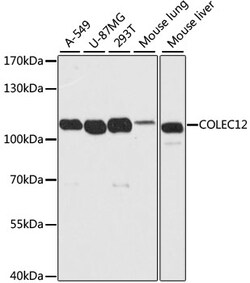
ABclonal Technology COLEC12 Rabbit pAb
This gene encodes a member of the C-lectin family, proteins that possess collagen-like sequences and carbohydrate recognition domains. This protein is a scavenger receptor that displays several functions associated with host defense. It can bind to carbohydrate antigens on microorganisms, facilitating their recognition and removal. It also mediates the recognition, internalization, and degradation of oxidatively modified low density lipoprotein by vascular endothelial cells.
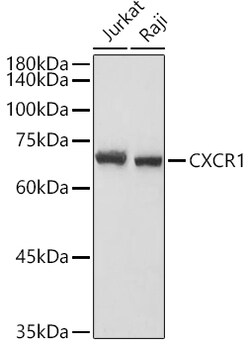
ABclonal Technology CXCR1 Rabbit pAb
The protein encoded by this gene is a member of the G-protein-coupled receptor family. This protein is a receptor for interleukin 8 (IL8). It binds to IL8 with high affinity, and transduces the signal through a G-protein activated second messenger system. Knockout studies in mice suggested that this protein inhibits embryonic oligodendrocyte precursor migration in developing spinal cord. This gene, IL8RB, a gene encoding another high affinity IL8 receptor, as well as IL8RBP, a pseudogene of IL8RB, form a gene cluster in a region mapped to chromosome 2q33-q36.
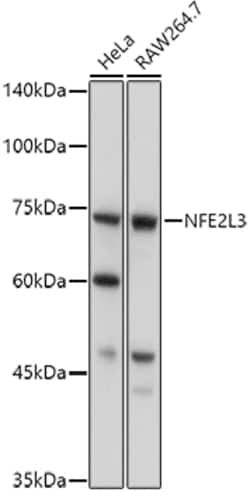
ABclonal Technology NFE2L3 Rabbit pAb
This gene encodes a member of the cap n collar basic-region leucine zipper family of transcription factors. The encoded protein heterodimerizes with small musculoaponeurotic fibrosarcoma factors to bind antioxidant response elements in target genes. This protein is a membrane bound glycoprotein that is targeted to the endoplasmic reticulum and the nuclear envelope. Pseudogenes of this gene are found on chromosomes 16, 17, and 18.
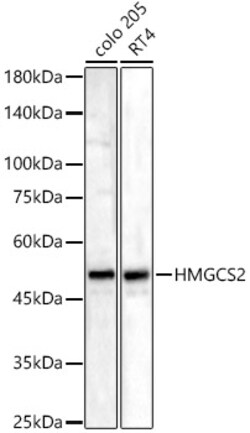
ABclonal Technology HMGCS2 Rabbit pAb
The protein encoded by this gene belongs to the HMG-CoA synthase family. It is a mitochondrial enzyme that catalyzes the first reaction of ketogenesis, a metabolic pathway that provides lipid-derived energy for various organs during times of carbohydrate deprivation, such as fasting. Mutations in this gene are associated with HMG-CoA synthase deficiency. Alternatively spliced transcript variants encoding different isoforms have been found for this gene.
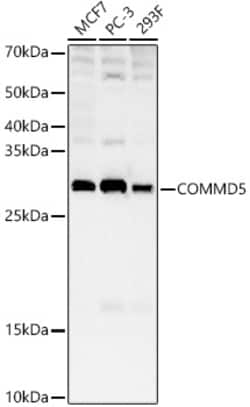
ABclonal Technology COMMD5 Rabbit pAb
Predicted to be involved in proximal tubule morphogenesis. Located in cytosol and nucleoplasm.
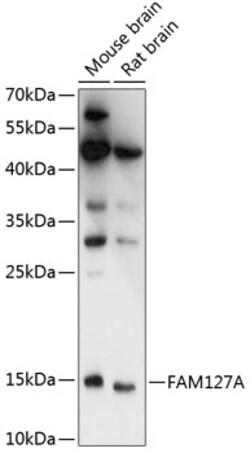
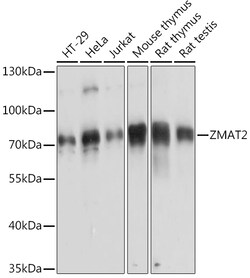
ABclonal Technology ZMAT2 Rabbit pAb
Predicted to enable DNA binding activity and zinc ion binding activity. Involved in mRNA splicing, via spliceosome. Located in nucleus. Part of U2-type precatalytic spliceosome.